The short version
- Usually some, rarely all. Whether you need new radiators is decided room by room, by comparing each room’s heat loss with what its radiator can deliver.
- Radiator outputs are rated for very hot water. At a typical heat pump temperature of 45°C, a radiator gives out roughly a third of the figure on its label.
- So at that temperature a room needs a radiator rated at about three times its heat loss. MCS’s heat emitter guide puts the figure at 3.1.
- A radiator that falls short can often be swapped for a deeper one the same size on the wall, and better insulation can mean you need to swap fewer.
The worry usually comes from a half-remembered rule: heat pumps need underfloor heating, or every radiator in the house has to go. Neither is true. Most heat pumps in the UK go into homes with ordinary radiators. But the radiators do matter more than they did with a boiler, and it helps to understand why.
Why a heat pump needs bigger radiators
A gas boiler typically sends water round your radiators at 70°C or more. A heat pump works most efficiently at much lower temperatures — often 45°C or below — and runs for longer to make up for it. The lower the water temperature it has to produce, the less electricity it uses for each unit of heat. MCS’s heat emitter guide rates systems from zero to six stars on exactly this basis: more stars for lower temperatures, because the heat pump runs more efficiently.
The catch is that cooler water gives off less heat. A radiator that kept a room warm with 70°C water from a boiler may not keep up at 45°C. To get the same heat into the room, you need more radiator surface, or a radiator designed to give off more heat for its size.
You could run the heat pump hotter instead. It will work, but it costs more to run, which is the opposite of what you are paying for. Our running cost comparison shows how much efficiency matters to the bill.

Before: a small, old radiator sized for 70°C boiler water struggles at heat pump temperatures.
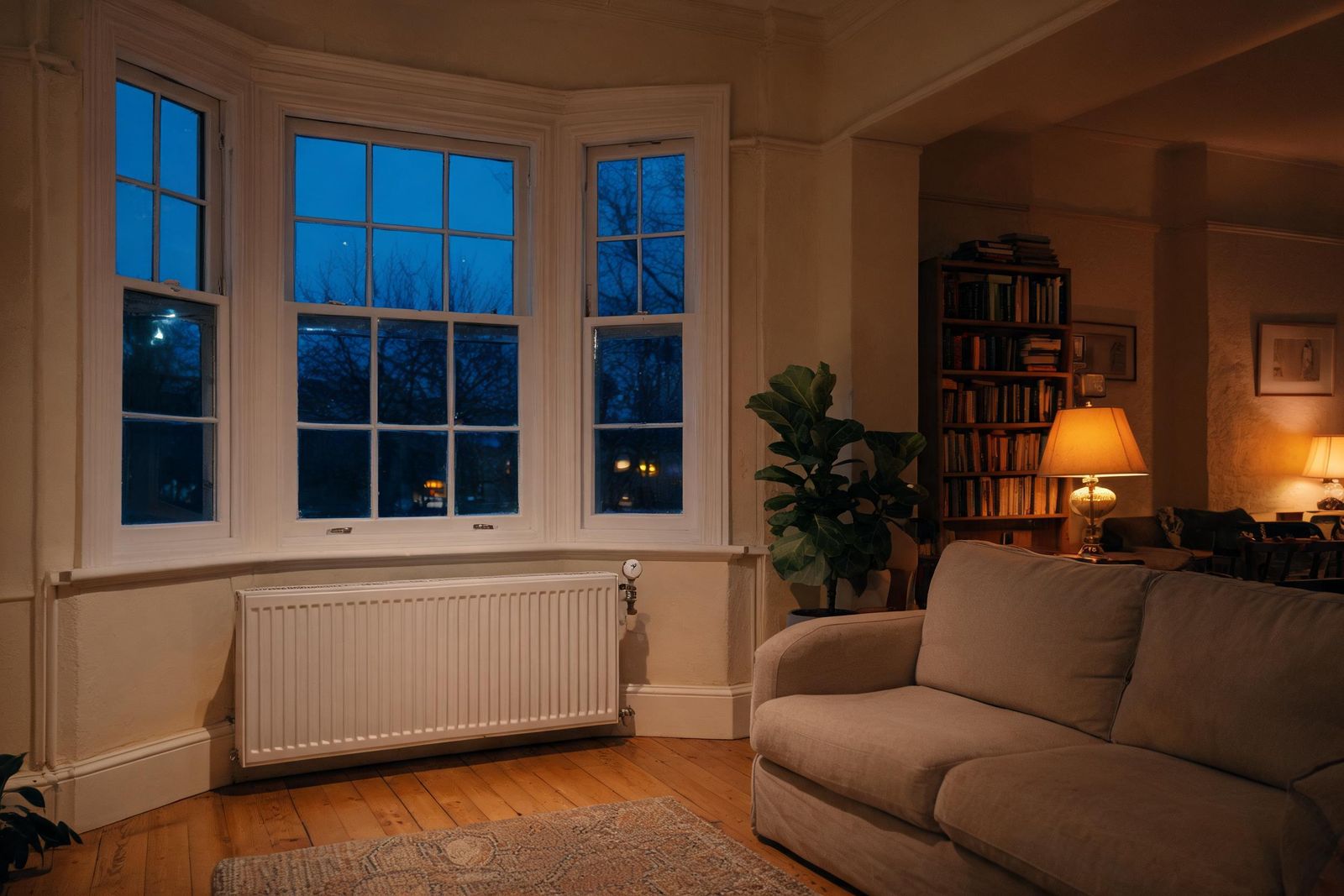
After: a larger, higher-output radiator keeps the room warm at a lower, more efficient flow temperature.
How much output a radiator loses
Radiator manufacturers publish outputs at a standard test condition: water averaging 70°C in a 20°C room, a difference of 50°C. When the water is cooler, output drops faster than the temperature does. The standard formula (from BS EN 442, the radiator testing standard) scales output by the temperature difference divided by 50, raised to a power of about 1.3 for ordinary panel radiators.
Here is what that means in practice, for a living room kept at 21°C:
| Flow temp | Water vs room | Output vs label | Radiator needed |
|---|---|---|---|
| 65°C | 41.5°C | 78% | 1.3× |
| 55°C | 31.5°C | 55% | 1.8× |
| 50°C | 26.5°C | 44% | 2.3× |
| 45°C | 21.5°C | 33% | 3.0× |
| 40°C | 16.5°C | 24% | 4.2× |
“Radiator needed” is the rated output required, as a multiple of the room’s heat loss. Our arithmetic, using the BS EN 442 formula with an exponent of 1.3, water returning 5°C cooler than it leaves, and a room at 21°C. Real radiators vary a little by type. MCS 021 gives an oversize factor of 3.1 for a radiator system designed at a 45°C flow temperature, which matches the table.
Read the last column like this: at a 45°C flow temperature, a room that loses 1,000 watts on a cold day needs radiators with a combined rated output of about 3,000 watts. If the radiator already in that room is rated at 3,000 watts or more, it stays. If it is rated at 1,800, it does not keep up on its own.
A worked example from the MCS guide
MCS’s heat emitter guide walks through one room, and it shows the options better than any sales pitch:
- As found. A poorly insulated room with single glazing loses 1,671 watts on a design day. Its double-panel radiator is rated at 1,938 watts. That is an oversize factor of just 1.2, so the heat pump would need to run above 60°C — the guide gives it no stars.
- Swap the radiator only. A double convector radiator with the same frontal area — the same size on the wall, just deeper — is rated at 3,269 watts. The factor rises to 2.0 and the room works at 55°C. Two stars.
- Insulate as well. With cavity wall insulation, double glazing, underfloor insulation and draught-proofing, the room’s heat loss falls to 976 watts. The same new radiator now gives a factor of 3.4, and the room works at 45°C. Four stars.
Two lessons come out of that. A replacement radiator does not have to take over more of the wall. And reducing heat loss often does as much as a bigger radiator, while cutting the bill as well.
Which rooms usually fall short
Every house is different, which is why the sum is done room by room. Some patterns do come up again and again:
- Rooms with a lot of outside wall or glass — corner bedrooms, bay-fronted living rooms, rear extensions with big glazed doors.
- Rooms whose radiator was sized to fit a space, not the room — a narrow radiator under a window, or a small towel rail in a bathroom that is expected to reach 22°C.
- Converted lofts and extensions, where heat was often added as an afterthought.
The rooms that usually pass are the ones with few outside walls. In a mid-terraced house, rooms lose little heat through the party walls, so the existing radiators often have the margin they need. Our guide to heat pumps in terraced houses goes into that in more detail.
Options when a room falls short
A radiator that cannot keep up is a design problem, and there are several ways to solve it:
- A higher-output radiator in the same place. Going from a single panel to a double panel, or a double panel to a double convector, adds output without taking up more wall.
- A larger radiator, or a second one, where there is wall space for it.
- Reduce the room’s heat loss. Draught-proofing, loft or wall insulation and better glazing all lower the heat the room needs, sometimes enough that the existing radiator is fine.
- Fan-assisted radiators. These push more heat out of a compact unit, which helps where wall space is tight. They need a power supply and make a little noise.
- Underfloor heating where a floor is being dug up anyway, such as a new extension. It is rarely worth retrofitting into an existing floor just for a heat pump.
The aim is to design the whole house around one sensible flow temperature. One undersized radiator can force the heat pump to run hotter for every room, so the weakest room sets the running cost for the whole house.
What about the pipes?
Your existing pipework can often stay. A heat pump moves more water than a boiler to deliver the same heat at a lower temperature, so the surveyor should check that the pipes can carry the flow each radiator needs. Very narrow “microbore” pipes can limit what a larger radiator can deliver, and occasionally some sections need replacing. It is a question to ask, not a reason to rule a heat pump out.
What a proper survey should give you
You should not have to take any of this on trust. A good heat pump quote comes with:
- A room-by-room heat loss calculation, with the heat loss of each room in watts.
- A design flow temperature for the system — the temperature the whole design is built around.
- A radiator schedule: each existing radiator, its output at that temperature, and whether it stays, is replaced or is added to.
- Any pipework changes, listed.
At ByEco, any radiator changes are listed room by room in the quote, so you can see exactly what is changing and why. The Boiler Upgrade Scheme grant of £7,500 goes towards the installation, and our heat pump cost guide covers what a typical installation costs. The grant has to be claimed by an MCS-certified installer; ByEco’s MCS and TrustMark certification is in progress.
Sources
Every figure on this page was checked against primary sources on 19 September 2026. Grant rules, planning rules and prices change — if you are reading this much later, verify before acting.
- MCS — MCS 021 Heat Emitter Guide for domestic heat pumps, Issue 2.1
- GOV.UK — Boiler Upgrade Scheme: what you can get
- GOV.UK — Boiler Upgrade Scheme: check if you’re eligible
Get a figure for your house
National averages only get you so far. Send us your postcode and a little about your home, and we will come back with a realistic price and an honest view on whether a heat pump suits it.