The short version
- Air source takes heat from the outside air through a fan unit. Ground source takes it from pipes buried in trenches or lowered into drilled boreholes.
- Ground source costs about twice as much to install: a median of £27,232 against £12,908 for air source (grant-funded jobs, April–June 2026, before the grant).
- The Boiler Upgrade Scheme grant is £7,500 for either type, so it does nothing to close that gap.
- Ground source is more efficient — a median seasonal performance of 3.26 against 2.69 in one large study — but the saving on bills is modest.
- All ten Greater Manchester boroughs are on the coalfield list, and drilling through a coal seam needs a Mining Remediation Authority permit.
Both types do the same job and get the same grant. The difference is where they collect heat, and that drives everything else: cost, space, paperwork, noise and efficiency.
How each type collects heat
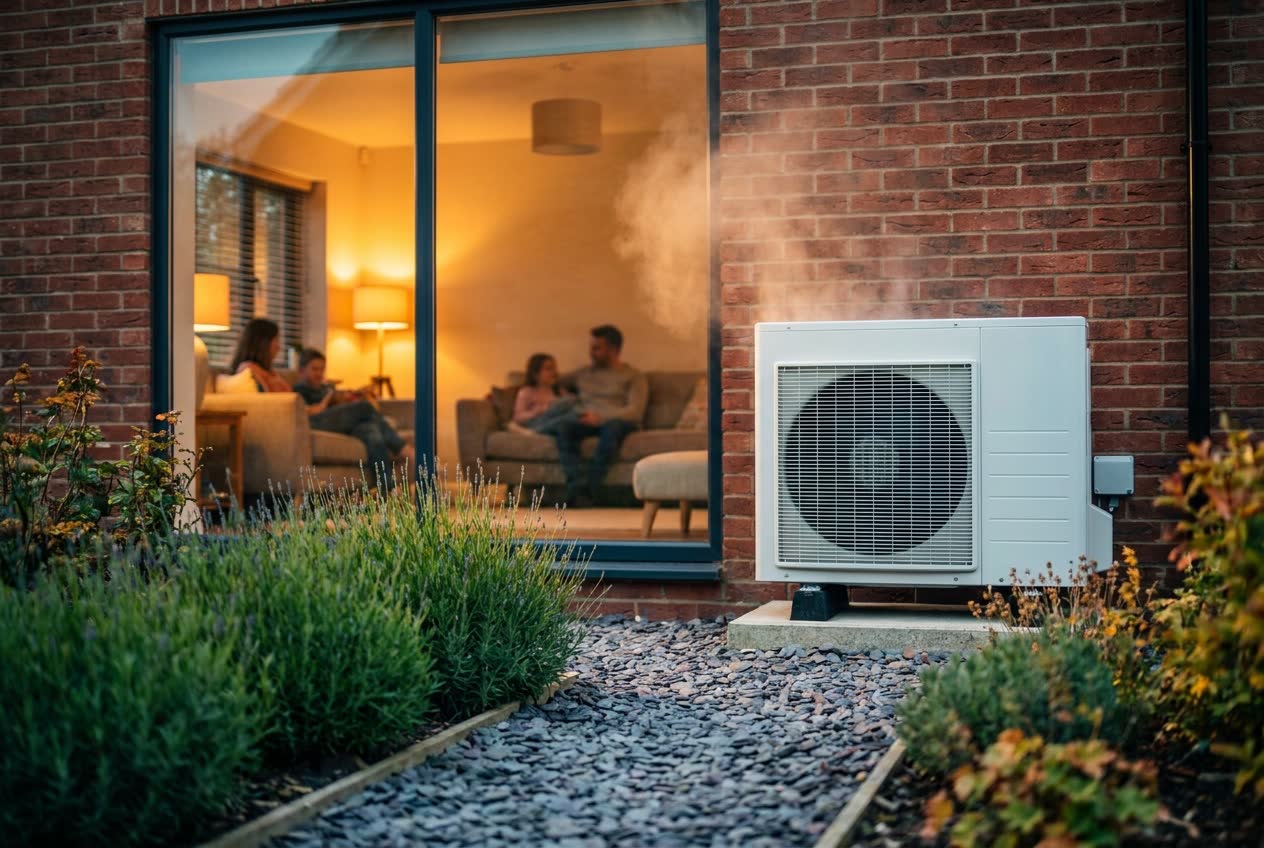
An air source heat pump sits outside: a fan draws air across a refrigerant coil, and a compressor lifts the heat to a useful temperature (see how an air source heat pump works).
A ground source heat pump sits indoors and draws heat from a loop of pipe buried in your garden, in trenches or a borehole, filled with water and antifreeze.
The advantage is the source temperature. Air is coldest when you need most heat; the ground changes far more slowly. The Welsh Government’s advice note puts the low-grade heat in the ground at 10 to 20°C almost everywhere in the UK, so the compressor works less hard.
Air source vs ground source at a glance
| Air source | Ground source | |
|---|---|---|
| Collects heat from | Outdoor air, through a fan unit | Pipes in trenches or boreholes |
| Where the heat pump sits | Outside | Indoors |
| Median installed cost, Apr–Jun 2026 (before grant) | £12,908 | £27,232 |
| Median size installed, Apr–Jun 2026 | 8 kW | 10.5 kW |
| Boiler Upgrade Scheme grant | £7,500 | £7,500 |
| Median real-world efficiency (SPF), 2017–2022 installs | 2.69 | 3.26 |
| Ground work | A base for the outdoor unit | Trenches or drilling |
| Outdoor noise | Fan unit; in England must pass the MCS 020(a) noise check for permitted development | No outdoor unit |
| Grant-funded installs to July 2026 | 88,092 | 1,567 (plus 37 on shared ground loops) |
Costs, sizes and installs: DESNZ Boiler Upgrade Scheme statistics, July 2026 (tables Q1.1A and 1.1), England and Wales, including the grant value. Efficiency: rb&m analysis of Ofgem metering data, 2024. Fewer than 2 in every 100 grant-funded heat pumps have been ground source.
Ground source heat pump cost in the UK
In April to June 2026, the median grant-funded ground source installation in England and Wales cost £27,232, against £12,908 for air source, both before the £7,500 grant is taken off.
Part of the gap is size: the median ground source system was 10.5 kW, against 8 kW for air source. But it does not go away when you compare like with like. For heat pumps of 8 to 10 kW in 2025/26, the median ground source job cost £21,298 (from only 61 jobs) and the median air source job £12,686 — about £8,600 apart.
Ground source prices also vary far more: the middle half of jobs in April–June 2026 cost between £18,136 and £42,110. One big variable is the ground work. The Energy Saving Trust puts a trench system at typically around £15,000 — well below the grant-scheme medians above — and says a borehole costs considerably more. For what moves an air source quote, see heat pump costs in Manchester.
Is there a ground source heat pump grant?
Yes, and it is the same as for air source. The Boiler Upgrade Scheme pays £7,500 towards a ground source heat pump in England and Wales — including water source heat pumps and shared ground loops — and £7,500 towards an air source one. The installer applies and deducts it from your quote.
Because the grant is a flat amount, it covers far more of an air source job. At the April–June 2026 medians, it would leave about £5,400 to pay for air source and about £19,700 for ground source. Both are zero-rated for VAT in homes until 31 March 2027, and for ground source that includes the groundworks. You must own the property, and the grant must be claimed by an MCS-certified installer; our Boiler Upgrade Scheme guide has the full rules.
Ground source vs air source efficiency
Efficiency over a year is measured as a seasonal performance factor (SPF): heat delivered divided by electricity used. An SPF of 3 means three units of heat for every unit of electricity.
A 2024 analysis of Ofgem metering data from more than 1,700 heat pumps installed in Great Britain between late 2017 and 2022, funded by DESNZ, the Renewable Energy Consumer Code and the Ground Source Heat Pump Association, found a median SPF of 3.26 for ground source and 2.69 for air source. The government-funded Electrification of Heat trial found a similar air source median of 2.78.
Two caveats. The ranges overlap — the middle half of air source systems ran at 2.26 to 3.07 and ground source at 2.83 to 3.64 — so a well-designed air source system can beat a poorly designed ground source one. And the report notes these homes were metered because they were unusual, so they may not represent every installation.
The gap shows most in cold weather. In the Electrification of Heat trial, air source efficiency fell to 2.30 at around −5°C, while a small group of ground source systems stayed above 3.0. That does not mean air source struggles to heat a home; see heat pumps in cold weather.
What the efficiency gap is worth
Worked example. Assumptions: electricity at the Ofgem price cap average of 26.32p per kWh (Direct Debit, October to December 2026), the median SPFs above, and a home needing 10,000 kWh of heat a year. Air source would use about 3,720 kWh of electricity (about £978), ground source about 3,070 kWh (about £807): a difference of about £171 a year. Against the £8,600 gap between the 8–10 kW medians, that takes around 50 years to recover, or around 25 years at 20,000 kWh. This ignores standing charges and any difference in lifespan or maintenance, which could narrow the gap. Your tariff and real performance will differ.
So the efficiency advantage is real but modest in pounds. See our running cost comparison with gas.
Borehole vs ground loop: space and ground work
Trenches (a horizontal ground loop) are the cheaper method. The Welsh Government’s note says they are typically 1.5 to 2 metres deep, and the Energy Saving Trust says a new-build three-bedroom house would need two trenches of 30 to 40 metres, with larger or less well-insulated homes needing more. The ground must be diggable, clear of trees and reachable by machinery from a road. That rules out most terraces: a yard reached through a ginnel or through the house will not take an excavator.
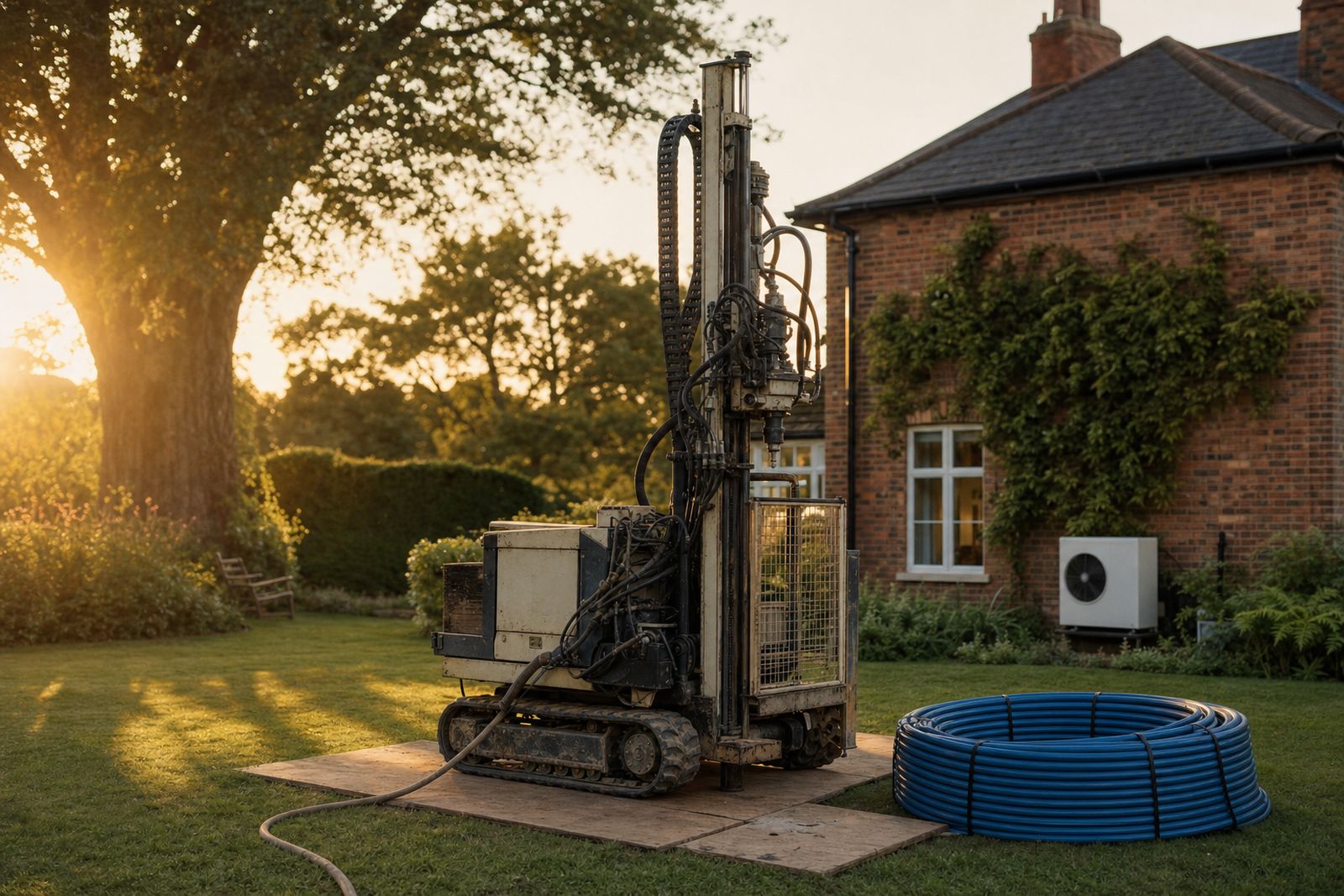
Boreholes suit smaller plots. The Energy Saving Trust says a borehole is about 20cm wide but 75 to 200 metres deep, depending on heat demand and geology; it usually costs more than trenches, usually needs a specialist ground survey, and larger homes may need more than one. The Welsh Government’s note says boreholes are usually spaced 5 to 10 metres apart, and the rig needs a way in.
Indoors it is the other way round: the ground source unit lives inside, and the Energy Saving Trust likens it to an American-style fridge. Whichever type you choose, ask exactly how hot water will be provided and what equipment goes where.
Permissions: planning, water and coal
Planning. In England, a ground source heat pump in a house’s garden is permitted development under Class C of Part 14 of the General Permitted Development Order, which sets no size or noise conditions. Air source (Class G) must be no bigger than 1.5 cubic metres, one per non-detached house, and comply with the MCS 020(a) noise calculation. Listed homes and conservation areas: check with your council. Wales has its own rules.
Water. In England, a new sealed closed-loop system (installed on or after 2 October 2023) must either meet the Environment Agency’s exemption conditions — for example, not being in a groundwater source protection zone 1 or within 50 metres of a well, spring or borehole supplying water for domestic or food production purposes — or meet the conditions of regulatory position statement RPS 307, or have an environmental permit. Open-loop systems, which pump groundwater out and back, need consent before drilling, an abstraction licence above 20 cubic metres a day, and a permit or exemption to discharge. In Wales, Natural Resources Wales regulates.
Coal under Greater Manchester. All ten Greater Manchester councils are on the government’s list of local planning authorities on the coalfield. You need a permit from the Mining Remediation Authority (the Coal Authority until November 2024) to drill boreholes through a coal seam, or for other ground work that could disturb coal seams or old mine workings. A standard application takes 20 or more working days, and no work should be scheduled until the permit is issued. Being on the coalfield does not mean there is coal under your garden, but a borehole installer should check the Authority’s map before quoting.
Noise, disruption and lifespan
Noise is where ground source wins outright: there is no outdoor fan, and the Welsh Government’s note says ground source systems generate no external noise. In England, an air source unit must comply with the MCS 020(a) noise calculation to count as permitted development, which matters on a tight terrace; see are heat pumps noisy?
Disruption runs the other way: ground source adds an excavator or drilling rig.
On lifespan, the Welsh Government’s note says ground source units tend to last up to twice as long as air source units — 20 years or more — because they have fewer moving parts and sit indoors, and that boreholes and buried pipes are designed to last at least 50 years.
Which is right for your home?
For most homes in Manchester, air source is the right answer. Many are terraces and semis with a yard or modest garden and no machine access to the back; air source costs about half as much and fits a small space (see heat pumps in terraced houses).
Ground source makes sense when several of these are true:
- You have a large garden or paddock with access for an excavator, or room for a drilling rig.
- Your home has a high heat demand, so the efficiency gain is worth more each year.
- You plan to stay a long time and value a loop designed to last decades.
- You are landscaping or building anyway, so the ground is being dug up regardless.
- An outdoor unit is not an option, because of noise, looks or a sensitive setting.
Shared ground loops, where several homes each connect their own heat pump to one communal loop, are a middle route, but rare: 37 grant-funded installations to the end of July 2026. Sizing matters for both types; see what size heat pump do I need? and heat pump pros and cons.
What to ask an installer
- A room-by-room heat loss calculation and the design flow temperature.
- The forecast seasonal efficiency, and how it was worked out.
- For ground source: trenches or boreholes, how long or deep, who does the ground work, and whether a ground survey is included.
- For ground source: whether they have checked the Mining Remediation Authority map and the Environment Agency exemption conditions.
- For air source: the position and the MCS 020(a) noise calculation.
- How hot water will be provided, and what equipment goes where.
See our heat pumps page. The grant has to be claimed by an MCS-certified installer; ByEco’s MCS and TrustMark certification is in progress. See our Manchester page, or get in touch for an honest view on which suits your home.
Sources
Every figure on this page was checked against primary sources on 19 September 2026. Grant rules, planning rules and prices change — if you are reading this much later, verify before acting.
- DESNZ — Boiler Upgrade Scheme statistics, July 2026 (tables 1.1, Q1.1A and A1.3A)
- GOV.UK — Boiler Upgrade Scheme: what you can get
- rb&m for DESNZ, RECC and GSHPA — In-situ heat pump performance: analysis of Ofgem data 2017–2022 (September 2024)
- Energy Systems Catapult for DESNZ — Electrification of Heat: Heat Pump Performance Data Analysis Report
- Energy Saving Trust — Ground source heat pumps
- Welsh Government — Demystifying heat from the ground: advice note
- legislation.gov.uk — GPDO 2015, Schedule 2, Part 14 (Classes C and G)
- Environment Agency — Closed loop ground source heating and cooling systems: when you need a permit
- Environment Agency — Closed loop ground source heating and cooling systems: exemption conditions
- Environment Agency — Open loop heat pump systems: apply to install one
- Mining Remediation Authority — Get a permit to deal with coal or coal mines
- Mining Remediation Authority — Planning applications and Coal Mining Risk Assessments (incl. list of local planning authorities on the coalfield)
- Mining Remediation Authority — Home extensions and improvements in former coal mining areas
- GOV.UK — New era as Coal Authority becomes Mining Remediation Authority
- Ofgem — Energy price cap unit rates and standing charges
- HMRC — VAT on energy-saving materials and heating equipment (Notice 708/6)
Get a figure for your house
National averages only get you so far. Send us your postcode and a little about your home, and we will come back with a realistic price and an honest view on whether a heat pump suits it.