The short version
- It moves heat rather than making it. A refrigerant collects heat from outdoor air, an electric compressor raises its temperature, and the heat passes into your heating water.
- COP is heat out divided by electricity in, at one test condition. SCOP is the same ratio averaged over a standard heating season.
- In real homes, a government-funded trial measured a median of 2.78 units of heat per unit of electricity over a year, across 428 air source heat pumps.
- Cooler water means higher efficiency: a median COP of 3.50 at 35°C against 2.38 at 55°C in the same trial.
A heat pump is not exotic technology. Your fridge uses the same cycle to move heat out of the food compartment and into the kitchen, which is why the Energy Saving Trust describes a heat pump as a refrigerator working in reverse. Here is what happens inside one, what the efficiency figures on a quote mean, and which choices decide how well it performs in your home.
What is a heat pump?
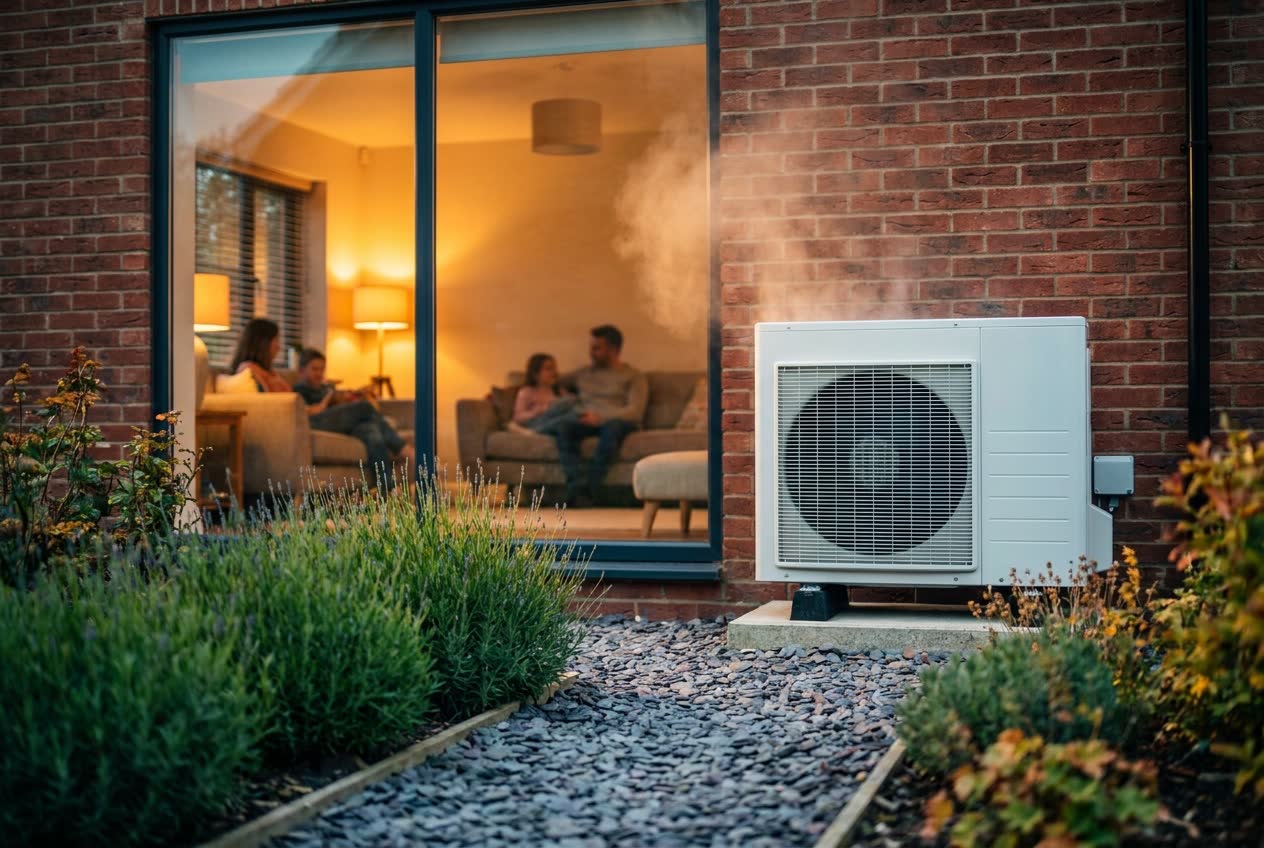
MCS, the standards body for small-scale renewables, defines a heat pump as a device that takes heat from a low-temperature source and upgrades it to a temperature that is useful for heating and hot water. An air source heat pump uses the outdoor air as that source, and the Energy Saving Trust says it is the most common type of domestic heat pump in the UK. A ground source heat pump takes its heat from the ground instead; see air source vs ground source for how the two compare.
Most air source heat pumps are air-to-water: they heat the water in your radiators or underfloor heating, and GOV.UK’s grant guidance treats the two names as the same thing. Air-to-air heat pumps blow warm air through indoor fan units instead and, as MCS notes, do not provide hot water. This guide is about air-to-water heat pumps, the kind that replaces a boiler.
How do heat pumps work? The refrigerant cycle in four steps
Outdoor air on a cold day still holds heat. The trick is the refrigerant, a fluid that boils at a very low temperature, so heat flows into it from air that feels cold to you. The Energy Saving Trust breaks this vapour-compression cycle into four stages:
- Evaporation. A fan draws outdoor air across a finned coil, the evaporator. The liquid refrigerant inside absorbs heat and evaporates into a low-pressure, low-temperature gas.
- Compression. An electric compressor squeezes the gas. Raising its pressure raises its temperature, just as a bicycle pump warms up as you use it.
- Condensation. In a second heat exchanger, the condenser, the hot gas gives up its heat to the water in your heating circuit and turns back into a high-pressure liquid.
- Expansion. An expansion valve drops the pressure, cooling the refrigerant below the outdoor temperature so it can absorb heat again. The cycle repeats for as long as the heat pump runs.
The electricity you pay for drives the compressor, the fan and the water pumps. Most of the heat that reaches your radiators comes from the air.
COP and SCOP explained
The coefficient of performance (COP) is the heat a heat pump gives out divided by the electricity it uses. A COP of 3 means 3 kWh of heat for every 1 kWh of electricity, with the other 2 kWh taken from the air. The Energy Saving Trust says heat pumps generally give three to four times as much heat as the electricity they use, against about 90% for an A-rated boiler. A heat pump can beat 100% because the figure counts only the energy you pay for.
The ecodesign rules for heat pumps, kept in UK law, define the rated COP at one standard test condition: outdoor air at 7°C, with water leaving at 55°C, or 35°C for a heat pump designed only for low temperatures. The seasonal coefficient of performance (SCOP) covers a whole standard heating season instead: the season’s heating demand divided by the electricity used to meet it. Both are calculated from laboratory tests. The ratio actually measured in a home over a year is the seasonal performance factor (SPF).
Why the water temperature matters
The further the compressor has to lift heat, from outdoor air up to your heating water, the lower the COP. The Electrification of Heat trial measured it:
| Water temperature leaving the heat pump | Median COP measured |
|---|---|
| 35°C | 3.50 |
| 55°C | 2.38 |
| Above 65°C | 2.02 |
Heat pump unit alone, 30-minute periods, all heat pumps in the trial. Source: Energy Systems Catapult, December 2024.
Efficiency also falls as the outdoor air gets colder; our guide to heat pumps in cold weather covers what that means in winter.
How efficient are heat pumps in real homes?
The Electrification of Heat demonstration project, funded by the Department for Energy Security and Net Zero, installed 742 heat pump systems in north-east and south-east England and south-east Scotland and monitored them between September 2020 and September 2023. Across 428 air source heat pumps, the median SPF was 2.93 for the heat pump unit alone and 2.78 for the whole system, including circulating pumps and back-up and immersion heaters. Half the systems fell between 2.55 and 3.05.
That whole-system median is up from 2.44 in an analysis of an earlier government scheme carried out in 2017, partly thanks to newer heat pumps. It is also below the three to four often quoted.
A design SCOP is an estimate. In 91.9% of the trial homes where the two could be compared, measured performance came in below the SCOP calculated at the design stage, and the median measured figure was 17.9% below the median design SCOP. A few systems matched or beat their design figure, so it can be done.
The trial linked part of the wide spread between homes to inconsistent design and installation quality: performance depends on how the system is designed, fitted and set up, not just the box. MCS design standards require the design flow temperature and the matching SCOP to be set out in writing before installation starts, and the Energy Saving Trust says your installer should share that performance calculation with you before any work begins. For how efficiency feeds into bills, see our heat pump vs gas boiler running costs comparison.
The outdoor unit and the indoor parts
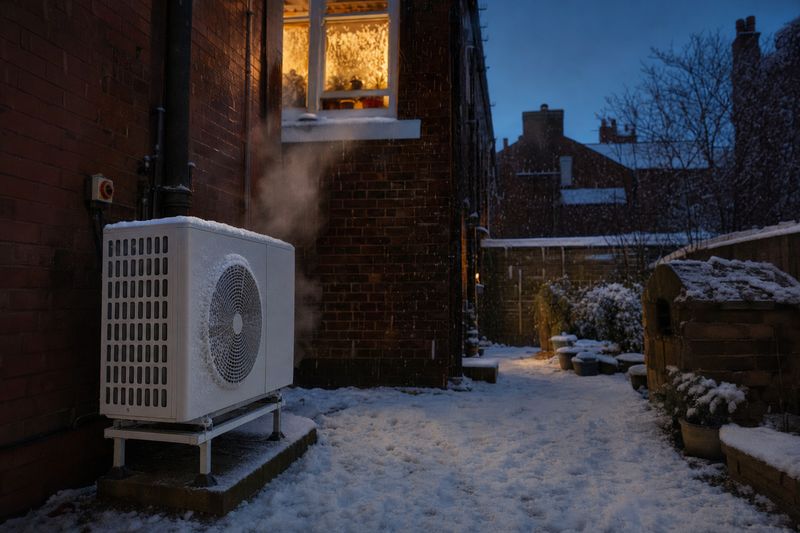
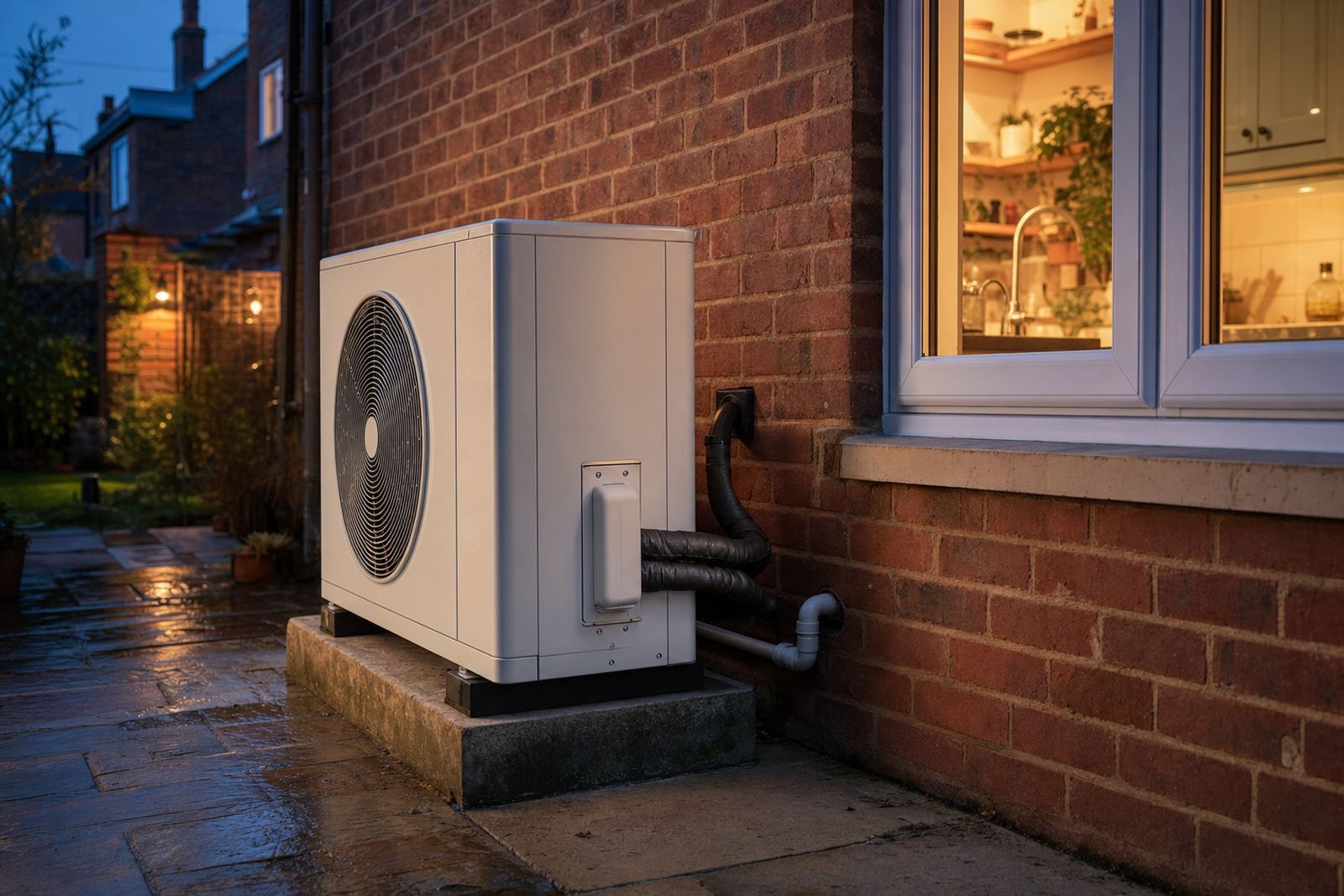
In a monobloc heat pump, the more common type, the whole refrigerant circuit sits in the outdoor unit, and insulated water pipes run from it into the house. The unit needs clear air around it, and the Energy Saving Trust advises keeping it clear of bikes, wheelie bins and leaves. Moisture condenses on the cold coil, and MCS rules require that water to drain safely to a drain or soakaway. In England, a unit fitted under permitted development must be no bigger than 1.5 cubic metres; see heat pumps in terraced houses for the siting rules and are heat pumps noisy? for sound.
Indoors there is a controller, pumps, valves and a filter for the heating water, and often an electric back-up heater; MCS rules say the heat pump itself must meet the whole design heat load without it. Hot water arrangements vary, so ask your installer to spell out how yours will be provided and what goes where.
Monobloc vs split heat pumps
Monobloc. All the components are in one outdoor unit, and the pipes into the house carry water. The Energy Saving Trust says monoblocs are more common because they are cheaper and quicker to install and take less indoor space, though slightly less efficient.
Split. The heat pump is divided into outdoor and indoor units joined by refrigerant pipework. Because some heat transfer happens inside the warmer building, split systems can be more efficient, at the cost of more indoor space and refrigerant work on site. MCS requires split-system installers to be qualified to handle refrigerants, and the Heat Pump Association notes that installing a split system containing a fluorinated gas (F-gas) legally requires F-gas training and registration.
Heat pump refrigerants: R32, R290 and R410A
The trial’s air source heat pumps used three refrigerants: R32 and R290 in newer models, and R410A, which is being phased out. The median whole-system SPF was 2.86 for both R32 and R290, against 2.66 for R410A, though the report notes that newer compressors and controls probably explain some of that gap.
R290 is propane. The Heat Pump Association gives it a global warming potential below 3 and a “higher flammability” safety class. It is not a fluorinated gas, so it falls outside current UK F-gas rules, and the association recommends that engineers who open a circuit containing it hold a formal qualification in flammable refrigerants. In a monobloc it stays inside the outdoor casing.
Controls and weather compensation
The most important setting is weather compensation, which the Energy Saving Trust also calls the heating curve. The controls set the water temperature by the outdoor temperature: warmer on a freezing night, cooler on a mild day, so radiators run just warm enough. Across the trial’s air source heat pumps, including those in hybrid systems, the average operating flow temperature was 39.7°C, and MCS installation rules say weather compensation should be enabled where it can optimise efficiency.
The Energy Saving Trust also recommends leaving the heat pump on with a lower “set-back” temperature overnight rather than switching it off and on like a boiler. If the electric back-up heater runs often, it says that can be a sign the radiators are too small or the heating curve is set wrong.
How a heat pump connects to your radiators
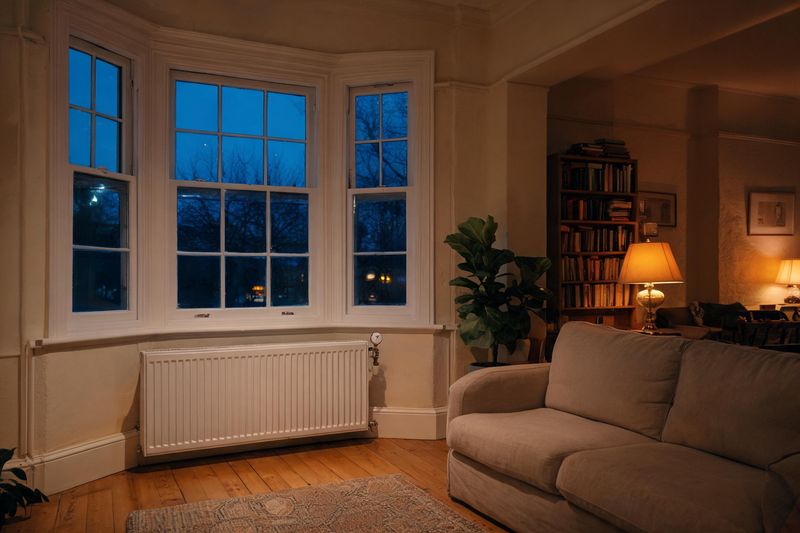
An air-to-water heat pump connects to the same wet heating system as a boiler: water is pumped round to radiators or underfloor heating and back. What changes is the temperature. The Energy Saving Trust notes a boiler typically runs at 75°C, while 45°C is usual for a heat pump.
Cooler water gives off less heat. MCS’s heat emitter guide gives an oversize factor of 3.1 for radiators designed for a 45°C flow, so each room needs radiators rated at about three times its heat loss. Some rooms pass as they are; others need a larger or deeper radiator. Our guide do I need new radiators for a heat pump? walks through the sum.
Running hotter costs efficiency. MCS design rules say a high-temperature heat pump should be avoided unless the job needs more than 55°C, and a design above 55°C should come with an alternative at 55°C or below. The room-by-room heat loss calculation also decides the size of heat pump; see what size heat pump do I need?
Defrosting the outdoor coil
In cold, damp weather, frost can build up on the outdoor coil and restrict the airflow. The heat pump clears it automatically, most commonly by reversing the flow of heat and drawing a little back from the heating system to melt the ice. You may see a small pool of water under the unit and some vapour rising from it. MCS expects an air source system to keep rooms at their design temperatures across repeated defrosts, and the trial’s efficiency figures include defrost energy. More in do heat pumps work in cold weather?
What to ask an installer
- What is the design flow temperature, and what SCOP does it give?
- Which rooms’ radiators need changing, according to the heat loss calculation?
- Is it monobloc or split, and which refrigerant does it use?
- Will you set up weather compensation and show me the heating curve?
- How will hot water be provided?
- Does the outdoor unit’s position pass the MCS 020(a) noise calculation?
ByEco is based in Manchester and installs air source heat pumps across England and Wales, with most of our work in Greater Manchester. The £7,500 Boiler Upgrade Scheme grant has to be claimed by an MCS-certified installer; ByEco’s MCS and TrustMark certification is in progress, so ask us where that stands. For the wider trade-offs, see our heat pump pros and cons. Read more about our heat pump installations or contact us to talk through your home.
Sources
Every figure on this page was checked against primary sources on 19 September 2026. Grant rules, planning rules and prices change — if you are reading this much later, verify before acting.
- Energy Saving Trust — Heat pumps: how they work, costs and savings (updated 16 July 2026)
- Energy Saving Trust — Air source heat pumps (updated 16 July 2026)
- Energy Saving Trust — The most efficient way to run a heat pump (19 May 2026)
- Energy Saving Trust — Your heat pump questions answered by our experts (updated 27 May 2026)
- Energy Systems Catapult for DESNZ — Electrification of Heat: Insights from Heat Pump Performance Data (December 2024)
- Energy Systems Catapult for DESNZ — Electrification of Heat Demonstration Project: Project Summary Report
- legislation.gov.uk — Regulation (EU) No 813/2013 (ecodesign for space heaters), Annex I definitions
- legislation.gov.uk — Regulation (EU) No 813/2013, Annex III standard rating conditions
- MCS — MIS 3005-D: The Heat Pump Design Standard, Issue 3.0 (December 2025)
- MCS — MIS 3005-D:2025 Heat Pump Design Standard, Issue 2.0 (December 2025)
- MCS — MIS 3005-I: Heat Pump Installation Standard (2025)
- MCS — MCS 021 Heat Emitter Guide, Issue 2.1
- Heat Pump Association — Position on training for flammable and fluorinated refrigerants (October 2025)
- MCS — Air source heat pump (consumer guide)
- GOV.UK — Apply for the Boiler Upgrade Scheme: what you can get
- Energy Systems Catapult for DESNZ — Electrification of Heat: Heat Pump Performance Data Analysis Report
- Warwick District Council — How to implement guide on air source heat pumps
- Perth & Kinross Council — Air source heat pump tenant user guide
Get a figure for your house
National averages only get you so far. Send us your postcode and a little about your home, and we will come back with a realistic price and an honest view on whether a heat pump suits it.