The short version
- A heat pump is not silent, but a well-sited modern unit makes a low hum. A 2023 review for the government found noise complaints were infrequent and often came down to where the unit was put and how well it was installed.
- In England, a heat pump only counts as permitted development if the MCS 020(a) calculation predicts no more than 37.0 dB(A) one metre outside every neighbouring window or door to a habitable room.
- Doubling the distance to the window cuts the level by about 6 dB. A solid wall that hides the unit from the window takes off 10 dB.
- If a position fails, the fixes are a different spot, a quieter model or a proper barrier. If none works, the job needs a planning application.
Noise is usually a question about the neighbours. A heat pump does make some noise, but in England the rules cap how loud it can be at the next-door window, and siting decides most of the result. It is one of the trade-offs in our heat pump pros and cons.
How loud is a heat pump?
The sound comes mainly from the compressor, the fan and the circulating pumps. MCS, which sets the industry’s installation standards, says monobloc units, with everything in one outdoor box, generally make more sound than split systems, and that modern heat pumps are generally much quieter than early models.
In the research behind the government’s 2023 review of heat pump noise, neighbours who were interviewed described a low hum or a rumble, and one survey response compared the sound to a fridge. Most neighbours surveyed did not report the sound as noticeable, although a small number said they could hear a neighbour’s heat pump from inside their home.
So how many decibels is a heat pump? That depends which of two figures you mean.
Air source heat pump decibels: sound power vs sound pressure
Sound power level is the total sound energy the unit gives out: a property of the machine, like the wattage of a light bulb. MCS says every heat pump sold in the UK must have its sound power tested and shown on its energy (ErP) label.
Sound pressure level is how much of that sound reaches one spot, such as a bedroom window. Like a bulb’s brightness, it depends on the distance and on what is in between.
Both are quoted in dB(A), weighted to match human hearing, so they are easy to mix up. The planning limit is a sound pressure level, and comparing it with the label’s sound power makes a heat pump look far louder than it will be next door. Label figures are a starting point, not a promise: the review cites ten week-long case studies in which units measured on site were on average 4 dB louder than their datasheets, and up to 8 dB louder. A position that passes with some margin is worth more than one that scrapes through.
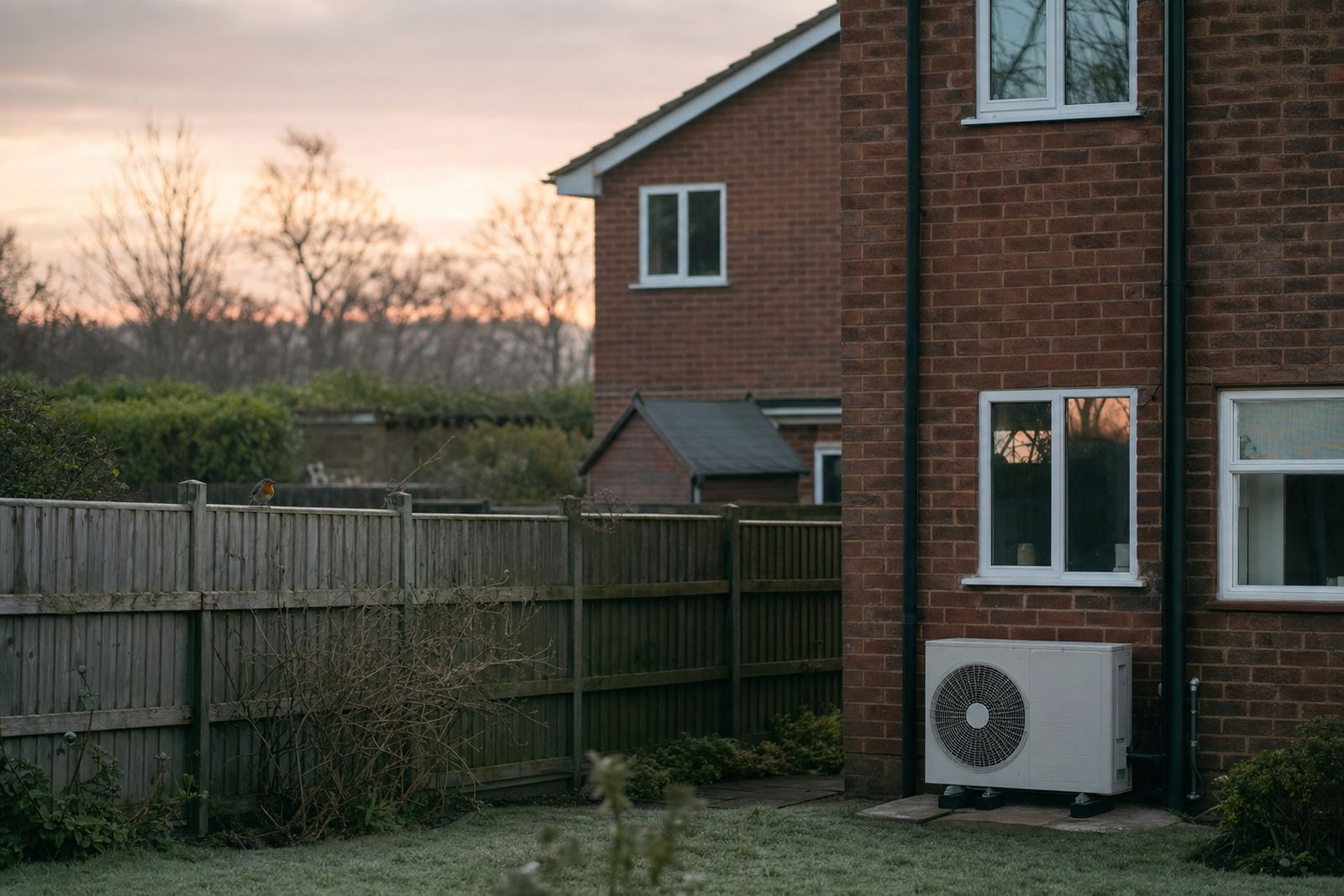
How heat pump noise level falls with distance
MCS 020(a) predicts the level at a neighbour’s window from the unit’s sound power with one formula. Three rules of thumb fall out of it:
- Distance. Each doubling of distance cuts about 6 dB. A unit with a sound power of 60 dB(A), on the ground against a wall, gives about 49 dB(A) at 2 metres, 43 dB(A) at 4 metres and 37.0 dB(A) at 8 metres.
- Reflecting surfaces. The ground or a wall counts if it is within 1 metre of the unit and extends at least 1 metre past its edge in two or more directions. Each extra surface adds about 3 dB, and a position with more than three, such as a small lightwell, cannot pass. Plants do not count.
- Barriers. A solid masonry wall, or a solid fence at least 18 mm thick with no gaps, reaching 1 metre past each side of the unit, takes off 10 dB if it completely hides the window from the top of the unit and 5 dB if it partly does. A thinner solid fence takes off 5 or 2.5 dB. Slatted fences and hedges take off nothing.
| Where the unit stands | No barrier | Solid wall, window partly visible | Solid wall, window hidden |
|---|---|---|---|
| In the open, on the ground (1 surface) | 5.7 m | 3.2 m | 1.8 m |
| On the ground against a wall (2 surfaces) | 8.0 m | 4.5 m | 2.6 m |
| On the ground in a corner (3 surfaces) | 11.3 m | 6.4 m | 3.6 m |
Shortest distance, to the next 0.1 metre, from the centre of the unit to a point 1 metre outside the window that comes out at 37.0 dB(A) or lower after rounding, for a sound power of 60 dB(A), the figure in MCS’s worked example rather than a typical one. Our arithmetic using the MCS 020(a) formula; “solid wall” means a Type 1 barrier. Every 6 dB off the sound power halves the distance.
The MCS 020 noise limit for permitted development
Class G of the General Permitted Development Order says an air source heat pump is not permitted development unless it complies with the MCS Planning Standards. Since 29 May 2025 that means MCS 020(a), Air Source Heat Pump Sound Calculation, Issue 1.1, dated 14 April 2025.
The limit is 37 dB LAeq,5mins, the A-weighted level averaged over five minutes, worked out by calculation rather than measured. It applies 1 metre outside the centre of any door or window to a habitable room of a neighbouring property. Habitable means rooms for living or sleeping, not bathrooms, hallways, utility rooms or a room used only for cooking. Your own windows are not assessed.
For every neighbouring window that could be affected, on all sides and every floor, the installer records:
- the date, and a description of the window;
- the unit’s A-weighted sound power from its energy label, product fiche or the MCS product database, never the “low noise mode” figure;
- the directivity, Q2, Q4 or Q8, from the number of reflecting surfaces;
- the distance from the centre of the unit, to the nearest 0.1 metre;
- any barrier correction;
- the calculated level, which must be 37.0 dB(A) or lower, rounded to one decimal place.
The installer must give you a copy of the completed table, and MCS says the standard applies whether or not the installation is MCS certified. Noise is only one condition: the size, number and position limits are in our guide to heat pumps in terraced houses.
42 dB or 37 dB? You will still see 42 dB quoted online. That was the limit in the older MCS 020 standard, and it included an assumed 40 dB(A) of background noise, so the government’s 2023 review describes the heat pump’s own effective limit as 37 dB(A). MCS 020(a) states the 37 dB figure directly.
What if the position fails the noise calculation?
A position that fails is not permitted development, but it does not rule out a heat pump. MCS’s noise guidance suggests:
- Moving the unit further away, more than 1 metre from a wall, or to where a solid wall blocks the view of the window.
- Adding a barrier. A Type 1 barrier that hides the window completely is worth 10 dB, the biggest single correction in the calculation.
- Choosing a quieter model. A lower sound power feeds straight through to the result.
A barrier that is part of the calculation has to stay: MCS says a removed one should be replaced with an equivalent as quickly as possible. Quiet mode is no way round it, because the calculation must use the normal figure.
If nothing works, you can apply for planning permission, and the council may ask for a noise impact assessment by an acoustic consultant. The government’s 2025 impact assessment estimated that about 60% of planning applications for a home heat pump would need one, at around £1,500 on average (range £1,000 to £2,000). Those are national estimates, not quotes.
Where to put a heat pump to keep it quiet
Complaints in the review often came down to position, including fans that faced the neighbour’s property rather than the owner’s garden. MCS’s guidance agrees:
- Away from bedroom windows, theirs and yours. MCS says units should not sit next to sleeping areas, and should face away from neighbouring homes and your own habitable rooms where possible.
- Out of corners, alcoves and enclosed spaces, where hard surfaces reflect sound back out.
- Behind solid walls, not flimsy screens. Only solid barriers with no gaps count.
- On anti-vibration mounts. Anti-vibration feet or pads, rubber grommets on wall brackets and flexible hoses on the water connections stop vibration travelling into walls and floors.
- Serviced. Loose parts, a blocked fan or missed maintenance can make a heat pump louder over time.
MCS notes that dense housing can find the calculation harder to pass, but that a unit which passes should have no worse an impact than one on a less crowded street. For what the outdoor unit is doing, see how an air source heat pump works.
Noise in cold weather and during defrost
MCS lists the times a heat pump is more noticeable: working harder in winter, heating hot water, running a defrost cycle, or needing maintenance. The review found disturbance was most often reported at night, when background noise is low.
Defrosting is normal. In cold weather ice can build up on the outdoor heat exchanger, and the heat pump clears it using heat from the water in the system. The sound changes while it does, but it is not a fault. Our guide to heat pumps in cold weather explains more.
At night, hot water heating can be scheduled away from sleeping hours, and a quiet or eco mode, where the unit has one, lowers fan and compressor speeds. MCS warns those modes can cut output and efficiency, so they suit particular hours, not a badly placed unit. How hard a unit works also depends on what size heat pump you need.
Heat pump noise and your neighbours
The independent review for the Department for Energy Security and Net Zero, published in November 2023, found a low incidence of heat pump noise complaints, usually about disturbed sleep and typically resolved by moving or replacing the unit. Of 300 heat pump planning applications it examined, 281 drew no objections about noise, and one was refused, for lack of information on noise attenuation.
For a whole street of heat pumps, MCS cites an Apex Acoustics and Nesta study which found the combined noise of several units in a dense neighbourhood is likely to be similar to one unit in the nearest neighbour’s garden.
If a neighbour complains in England, an installation that does not meet MCS 020(a) can face planning enforcement, and councils must look into noise that could be a statutory nuisance and can serve an abatement notice. MCS suggests first checking for loose parts, missed maintenance or a change such as a removed fence.
If you live in Wales
The 2025 changes above were made to England’s rules. Wales has its own permitted development rules, which the Welsh Government updated for air source heat pumps on 1 June 2026. They also require compliance with MCS 020(a), so the same sound calculation applies. Other conditions differ, so check the Welsh Government’s guidance or ask your council before you commit.
What to ask your installer
A good quote answers the noise question with numbers. Ask:
- Can I see the MCS 020(a) calculation for every neighbouring window you assessed?
- Which sound power figure did you use, where did it come from, and is it the normal-mode figure?
- Are you relying on a barrier? If so, what type, and who builds and maintains it?
- How much margin is there below 37.0 dB(A) at the worst window?
- Which anti-vibration measures are included, and can hot water be scheduled away from night-time?
If you get a quote from us, ask for the sound calculation alongside the heat loss figures. ByEco’s MCS and TrustMark certification is in progress. MCS 020(a) applies whatever the installer’s certification, but the £7,500 Boiler Upgrade Scheme grant has to be claimed by an MCS-certified installer. See heat pump costs in Manchester and our heat pumps page, or get in touch; we cover Manchester and the rest of our service areas.
Sources
Every figure on this page was checked against primary sources on 19 September 2026. Grant rules, planning rules and prices change — if you are reading this much later, verify before acting.
- MCS — MCS 020 a) Air Source Heat Pump Sound Calculation (for permitted development installations), Issue 1.1
- MCS — Installation guidance for mitigating noise from air source heat pumps
- MCS — MCS has published an updated version of MCS 020
- legislation.gov.uk — The Town and Country Planning (General Permitted Development) (England) (Amendment) Order 2025 (S.I. 2025/560)
- legislation.gov.uk — GPDO 2015, Schedule 2, Part 14 (Class G, air source heat pumps)
- GOV.UK — Air source heat pump noise emissions, planning guidance and regulations (DESNZ review, 2023)
- legislation.gov.uk — Impact assessment: amendments to the permitted development right for air source heat pumps (2025)
- GOV.UK — Noise nuisances: how councils deal with complaints
- GOV.WALES — Planning permission: domestic heat pumps
- Energy Saving Trust — Heat pump installer toolkit: system volume and frost protection
Get a figure for your house
National averages only get you so far. Send us your postcode and a little about your home, and we will come back with a realistic price and an honest view on whether a heat pump suits it.