The short version
- Yes. An air source heat pump takes heat from outdoor air even below freezing. The manual for one range, the Vaillant aroTHERM plus, for example gives a heating range down to -25°C.
- It does get less efficient in the cold. In the government-funded Electrification of Heat trial, the median efficiency of air source heat pumps fell from 3.37 at 10°C to 2.30 at -5°C — still more than two units of heat per unit of electricity, with defrosting counted.
- In Manchester, the MCS design standard sizes a heat pump to heat your whole home at -2.7°C or -4.5°C outside, depending on the installer’s assessment of your location.
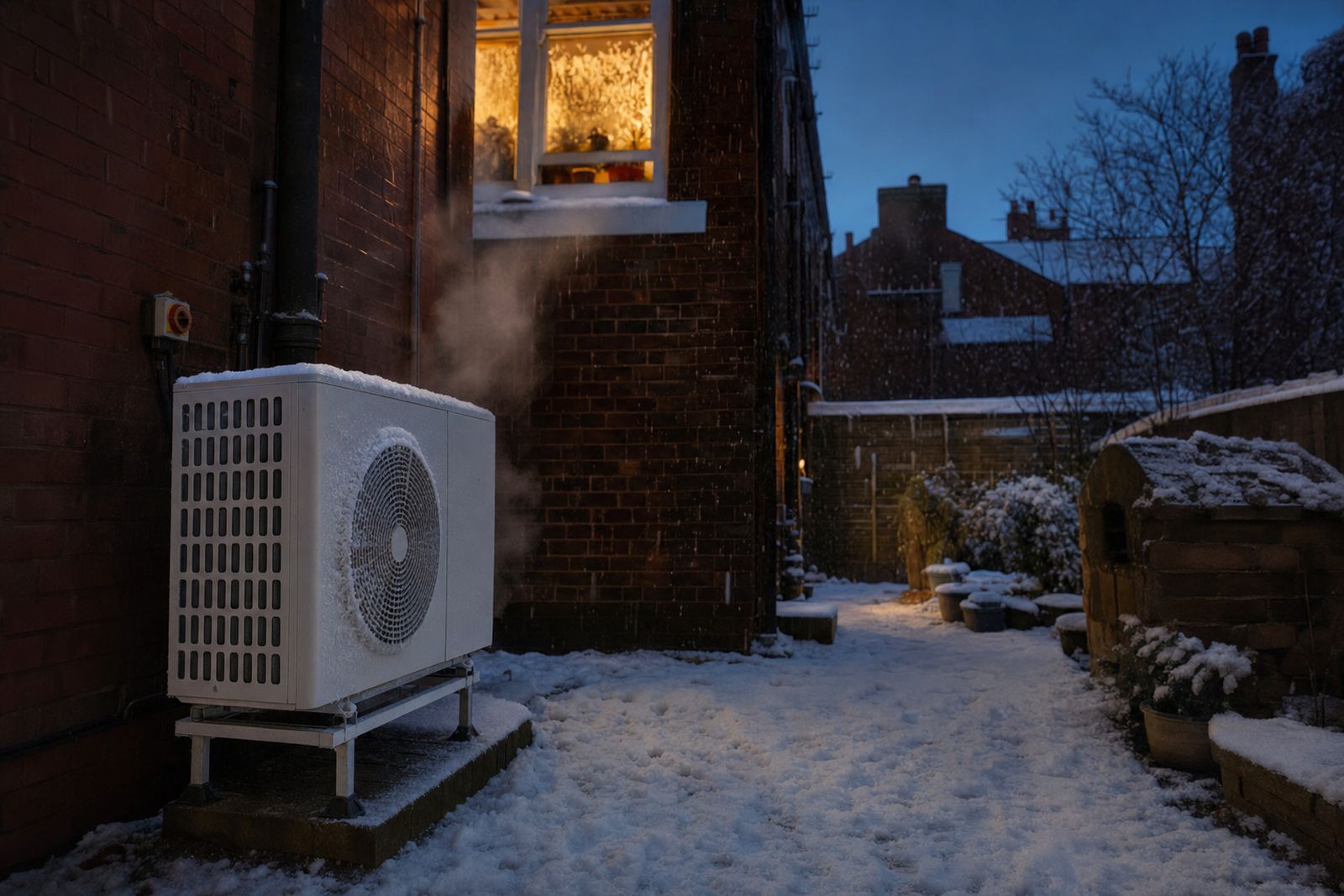
- Steam and a little frost on the outdoor unit in winter are normal: that is the defrost cycle. Leave the heat pump running, and keep the unit clear of snow and leaves.
“Will it cope in January?” is the question most people ask about a heat pump. A heat pump keeps working through a normal English or Welsh winter, frosty spells included. What changes in the cold is how much electricity it needs for each unit of heat — and whether it was sized and set up for your winter in the first place.
How a heat pump finds heat in cold air
Cold air still holds heat. As the Energy Saving Trust puts it, even when it feels cold there is still plenty of heat in the air that can be used. The refrigerant in the outdoor unit is expanded until it is colder than the outside air, so heat flows into it even on a frosty morning; a compressor then lifts it to a useful temperature. Our guide to how an air source heat pump works goes through each step.
The colder the air, the harder that lift, so in winter both the efficiency and the most heat the unit can put out fall. Neither means it stops. The installation and operating manual for the Vaillant aroTHERM plus says it works in heating mode from -25°C to 43°C outdoors, and switches off outside that range. We use it only as an example of a published figure; other makes publish their own.
How efficiency changes below freezing
Efficiency is measured as a coefficient of performance (COP): units of heat per unit of electricity. Good UK evidence comes from the Electrification of Heat demonstration project, funded by the Department for Energy Security and Net Zero. It installed and metered 742 heat pump systems in homes in North East England, South East England and South East Scotland. Its final analysis, published in December 2024, grouped each half-hour of operation by the outdoor temperature at the local Met Office weather station:
| Outdoor temperature | Half-hours measured | Median COP |
|---|---|---|
| 0°C | 100,478 | 2.57 |
| -1°C | 51,895 | 2.50 |
| -2°C | 35,653 | 2.44 |
| -3°C | 23,578 | 2.37 |
| -4°C | 14,787 | 2.33 |
| -5°C | 7,440 | 2.30 |
| -6°C | 4,816 | 2.32 |
Source: Electrification of Heat, Heat Pump Performance Data Analysis Report, Table 10.1: median COP(H4) of all air source heat pumps. H4 covers the whole heating system, including pumps and any backup heater, and the report says defrosting energy is included.
Efficiency does fall: at 10°C the same median was 3.37. But the fall levels off rather than collapsing, and between -3°C and -6°C it barely moved. The report records 2.08 at -10°C, from too few half-hours to be sure of. For comparison, the trial’s own user guide puts an efficient gas boiler at a COP of around 0.9.
Your home also needs more heat on a cold day, so electricity use rises for two reasons. Median electricity use per half-hour rose from 0.59 kWh at 0°C to 0.84 kWh at -5°C. By our arithmetic, each unit of heat took about 12% more electricity at -5°C than at 0°C. Efficiency is not the same as cost, because electricity costs more per unit than gas; our running cost comparison does that sum over a year.
What the coldest days in the trial showed
The trial also measured each home’s coldest winter day in its monitoring period as a whole. Across 510 air source heat pumps, the median COP over that day was 2.27, and half fell between 2.04 and 2.49. The most common of those days were in the cold spells of winter 2021–22.
The spread matters. The report puts it down to the same things that separate good and poor systems over a year — the heat pump model, the controls and the temperature of the water it has to produce — plus day-to-day factors such as how warm the house was beforehand, open windows and unmetered log fires. Across all the trial’s heat pumps, the median COP was 3.50 when sending water out at 35°C and 2.38 at 55°C. A system whose radiators can keep rooms warm with cooler water stays efficient on a frosty day, which is why radiator sizing is part of the winter story.
Over a whole year, the median air source system (428 with enough good data) delivered 2.78 units of heat per unit of electricity. Ground source heat pumps held a COP above 3.0 down to -5°C, from a small sample; see air source vs ground source.
Do heat pumps work in the UK climate?
Yes. The trial report notes that every UK design temperature in the MCS heat pump standard falls between 0°C and -6°C, well inside the operating range quoted above. Countries with harsher winters already rely on them heavily: the International Energy Agency’s 2022 report The Future of Heat Pumps found that 60% of buildings in Norway have heat pumps, and more than 40% in Sweden and Finland — which, the agency said, undercuts the argument that heat pumps do not suit cold climates.
Sized for a Manchester winter: the design temperature
A heat pump is not sized for the coldest night on record but for a design outdoor temperature: a level your area only rarely drops below. The MCS heat pump design standard, which MCS-certified installers must follow, takes these from CIBSE Guide A, the building services industry’s reference data:
| Location | Altitude | Column A (99% of hours) | Column B (99.6% of hours) |
|---|---|---|---|
| Manchester | 75 m | -2.7°C | -4.5°C |
| Birmingham | 96 m | -3.2°C | -5.1°C |
| London | 25 m | -1.7°C | -3.0°C |
| Cardiff | 67 m | -1.5°C | -3.1°C |
The hourly outdoor temperature equalled or exceeded for 99% or 99.6% of the hours in a year. Source: MCS MIS 3005-D, Table 2, from CIBSE Guide A Table 2.5.
So Manchester’s air is at or above -2.7°C for 99% of the year’s hours and at or above -4.5°C for 99.6%. A year has 8,760 hours, so by our arithmetic that leaves around 88 hours below the first figure and around 35 below the second. The installer picks column A or B from their assessment of the building’s location; the Manchester figures are for 75 metres above sea level, so on higher ground ask which they used.
The heat loss is then worked out room by room, with rooms held at no less than set temperatures — 21°C for a living room, 18°C for a bedroom, 22°C for a bathroom — and the heat pump must supply at least 100% of it at the design temperature, at the flow temperature it will run at, without any electric backup heater. The sizing maths is in what size heat pump do I need?
What happens at minus temperatures below the design point?
In the relatively few hours a year colder than that, the heat pump keeps running but may not quite keep up on its own. The Energy Saving Trust says heat pumps can perform down to -15°C or lower, and that needing a little help in the coldest periods is quite normal. That help comes from an extra electric heater element, sometimes labelled ‘heating boost’ on the controls.
The MCS standard says any backup electric heater must be designed not to operate above the design temperature. So if yours comes on often in ordinary winter weather, talk to your installer: the Energy Saving Trust says it can mean the radiators are too small or the heating curve is set wrong.
Heat pump defrost: why you see steam and ice
The outdoor coil runs colder than the air around it. Moisture condenses on it and, when the coil is below freezing, turns to frost that would block the airflow. The Energy Saving Trust’s installer guidance says domestic heat pump systems must defrost at times to stop ice building up on the outdoor heat exchanger, using heat from the water in the heating system. What you might notice:
- A cloud of vapour from the unit. Vaillant’s manual tells owners they need do nothing: it can happen while the unit thaws.
- Water dripping underneath as the frost melts.
- Defrosting above zero. The trial’s user guide warned that a heat pump may defrost in winter even when it is not freezing.
None of this is a fault: the MCS design standard says an air source system should keep rooms at their design temperatures across multiple defrost cycles, and Vaillant specifies a minimum water volume in the heating system partly so the unit can defrost. Never try to defrost it yourself — no chipping at ice, no kettles of hot water — and never open the casing. If it stays iced up, call your installer.
How to run a heat pump in a UK winter
Leave it running steadily
The Energy Saving Trust advises keeping a heat pump on all the time with a set-back — a few degrees cooler when you are out or asleep — rather than switching it off. The trial’s user guide explained why: a gas boiler typically heats a house in about half an hour, but a heat pump may take a few hours once the house has gone cold, and turning the thermostat up does not speed it up.
Keep the power on in a cold snap
Some systems rely on the heat pump to stop the water in the outdoor unit from freezing. Vaillant’s manual tells owners to keep the unit switched on for frost protection unless the system has separate protection. If you go away, use the holiday setting, not the isolator switch.
Let weather compensation do the work
Weather compensation raises the radiator water temperature as it gets colder outside and lowers it in milder spells. The MCS installation standard says it should be enabled wherever it improves efficiency. If the heating curve has been set high to be safe, the Energy Saving Trust suggests lowering it one degree at a time until the house feels too cold, then going back up one.
Keep it clear of snow and leaves
The Energy Saving Trust says to keep the unit clear of bikes, wheelie bins and leaves, and Vaillant’s manual says to clear snow from the air grilles and from around the unit. Where snow drifts, the unit can be raised: Vaillant, for instance, sells a ‘snow spacer’ and wall brackets.
Check the condensate drain
The MCS installation standard requires condensate to go safely to a suitable drain or soakaway. Vaillant’s manual warns that condensate frozen on a path can cause falls, and in some locations calls for electric trace heating to keep the pipe from freezing. If ice builds up under the unit or across a path, tell your installer — and, as the Energy Saving Trust advises, get the heat pump serviced once a year.
What to ask an installer, and where ByEco stands
Before you sign, ask:
- Which design outdoor temperature, column A or B, did you use for my address, and why?
- What flow temperature will the system need on that design day, and are my radiators big enough for it?
- Will the heat pump meet the full heat loss at that temperature without the backup heater?
- Is weather compensation enabled, and how do I adjust it?
- Where will the condensate drain, and how will it be kept from freezing?
ByEco is based in Manchester and installs air source heat pumps in England and Wales, mostly in Greater Manchester (see heat pump installation in Manchester). ByEco’s MCS and TrustMark certification is in progress. The £7,500 Boiler Upgrade Scheme grant can only be claimed through an MCS-certified installer; our guide to the Boiler Upgrade Scheme explains how it works. For a straight answer on how a heat pump would cope with your house in January, get in touch.
Sources
Every figure on this page was checked against primary sources on 19 September 2026. Grant rules, planning rules and prices change — if you are reading this much later, verify before acting.
- Energy Systems Catapult for DESNZ — Electrification of Heat Demonstration Project: Heat Pump Performance Data Analysis Report (December 2024)
- Energy Systems Catapult — Electrification of Heat: Your new heat pump (low temperature air source user guide)
- GOV.UK (DESNZ) — Electrification of Heat Demonstration Project: winning bids, case studies and project data
- MCS — MIS 3005-D:2025 The Heat Pump Design Standard, Issue 2.0 (5 December 2025)
- MCS — MIS 3005-I:2025 The Heat Pump Installation Standard, Issue 1.0
- Energy Saving Trust — The most efficient way to run a heat pump (updated 19 May 2026)
- Energy Saving Trust — Your heat pump questions answered by our experts
- Energy Saving Trust — Heat pumps: how they work, costs and savings
- Energy Saving Trust Green Heat toolkit — System volume and frost protection
- Vaillant — aroTHERM plus VWL 35/6 to 75/6 A S2 operating, installation and maintenance instructions
- Vaillant — aroTHERM plus installer’s quick guide (03/2024)
- International Energy Agency — The Future of Heat Pumps: Executive summary (2022)
Get a figure for your house
National averages only get you so far. Send us your postcode and a little about your home, and we will come back with a realistic price and an honest view on whether a heat pump suits it.